Introduction
The e-Shram Card is a government initiative designed to create a centralized database of unorganized workers across India. By registering on the e-Shram portal, workers receive a unique identification card that gives them access to various social security schemes and benefits. Understanding what the e-Shram Card is, who it is for, and how it works can help workers secure greater financial and social protection.
What is the e-Shram Card and Why It Was Introduced
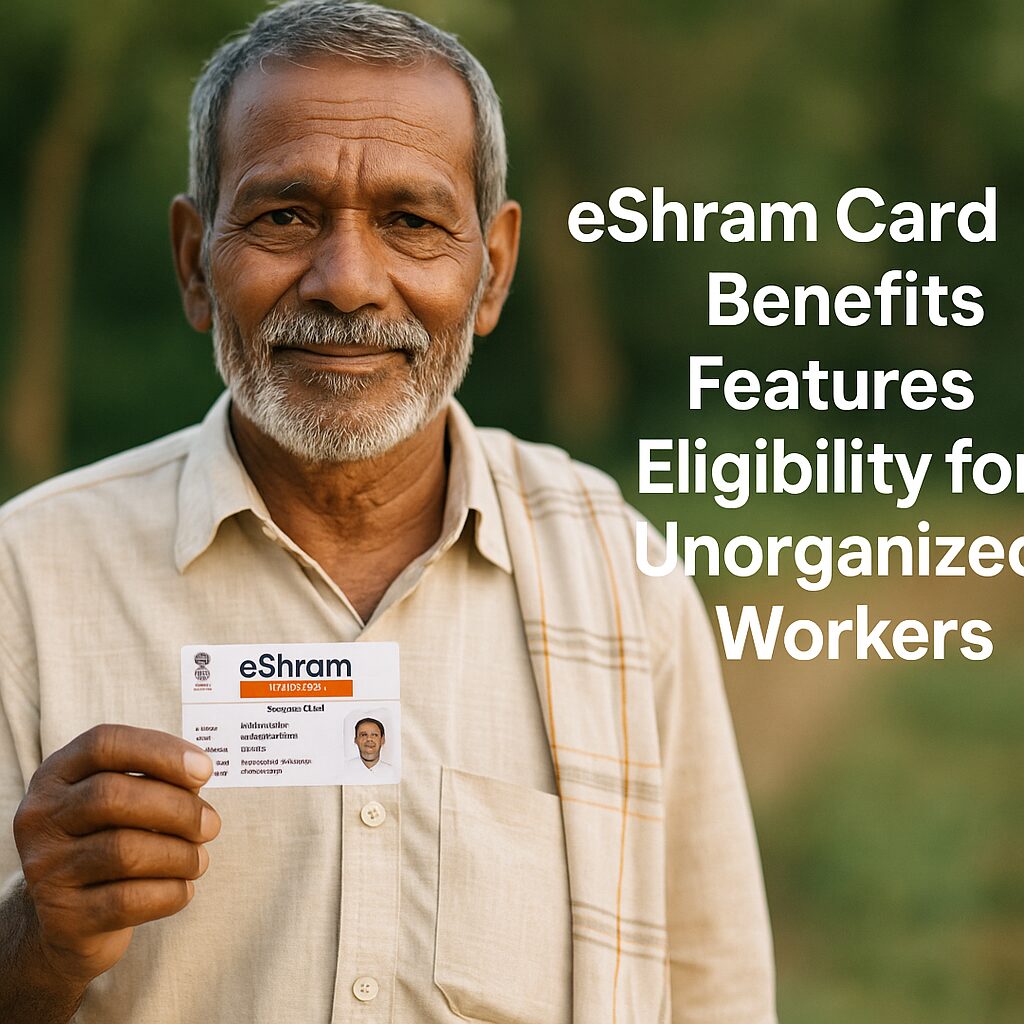
The e-Shram Card is an electronic identification card issued by the Ministry of Labour and Employment, Government of India, under the e-Shram portal initiative. It is specifically designed for workers in the unorganized sector, a segment that often remains outside the formal social security network.
The unorganized sector includes workers who usually do not have formal contracts, fixed salaries, or access to benefits like provident fund, health insurance, or paid leave. To address this gap, the government created the e-Shram portal as a national database of such workers. Each registered worker is issued a 12-digit Universal Account Number (UAN) and an e-Shram Card linked to their Aadhaar.
Key objectives of the e-Shram Card:
- Creation of a national database: To maintain a centralized, accurate record of unorganized workers across all states and sectors.
- Targeted delivery of social security: To ensure that welfare schemes and benefits reach the right beneficiaries without duplication or leakage.
- Policy formulation: To provide reliable data that governments can use to design better labour, welfare, and social protection policies.
- Portability of benefits: To allow workers to access benefits even if they migrate between states or change jobs within the unorganized sector.
Who is an unorganized worker?
Unorganized workers include a wide variety of occupations and income levels, such as:
- Construction workers, daily wage labourers, and contract workers
- Street vendors, rickshaw pullers, auto drivers, and gig workers
- Domestic workers, home-based workers, and caregivers
- Agricultural labourers, fishers, and allied sector workers
- Small shop helpers, delivery personnel, and other informal employees
The e-Shram Card is intended for Indian citizens in the age group usually defined by the scheme (commonly 16–59 years), working in the unorganized sector and not already covered by formal social security systems like EPFO or ESIC in a comprehensive way.
Main Features and Benefits of the e-Shram Card
The e-Shram Card is more than just an identity card; it serves as a gateway to multiple welfare measures. Its value lies in both present and future benefits that accrue to registered workers.
1. Unique identification and digital record
- Each worker receives a unique 12-digit UAN that remains the same throughout their life, even if they change occupations or locations.
- The worker’s personal, occupational, and bank details are stored in the national database, enabling smoother access to schemes without repeated paperwork.
- The e-Shram Card is usually downloadable and printable, and in many cases accessible via mobile, ensuring workers can carry proof of registration easily.
2. Access to social security schemes
One of the main reasons for introducing the e-Shram Card is to seamlessly connect workers to existing and future government schemes. These can include:
- Insurance and accident coverage: Certain schemes linked to the e-Shram database may provide accident insurance, partial disability, and death benefits to registered workers.
- Pension and old-age support: In the long term, the database helps identify and enroll eligible individuals in pension schemes for unorganized workers.
- Health and maternity benefits: Integration with health insurance programmes and maternity benefit schemes becomes more efficient when worker data is already available.
- Skill development and employment support: Data on occupations and skills enables targeted skill upgradation and job matching services.
3. Portability for migrant and seasonal workers
- Workers who migrate from one state to another, or shift between jobs frequently, can still retain the same UAN and e-Shram Card.
- This portability allows benefits to follow the worker instead of being restricted to a particular employer or location.
- It improves access to emergency support, disaster relief, or targeted cash transfers where governments rely on the e-Shram database.
4. Foundation for future welfare measures
- The e-Shram database is designed as a long-term infrastructure for welfare delivery, similar to how Aadhaar supports identity verification.
- As more schemes are integrated, workers who already have an e-Shram Card may receive benefits automatically or with minimal additional registration.
- It also helps reduce duplication and fraud by linking benefits to verified worker profiles.
Basic eligibility and registration logic
While specific eligibility and conditions may evolve, the general logic behind registration includes:
- Indian citizenship and belonging to the unorganized workforce.
- Possession of an Aadhaar number linked with a mobile number, and usually a bank account for direct benefit transfer.
- Self-registration through the official e-Shram portal or assisted registration via Common Service Centres (CSCs) to ensure inclusion of workers with limited digital access.
The process is meant to be simple, free of cost from the government side, and accessible even to those with low literacy, using assisted services. Once registered, updating details like address, occupation, or mobile number is encouraged so that the database remains accurate and workers continue to be reachable for new schemes.
Conclusion
The e-Shram Card is a critical step towards formally recognizing India’s vast unorganized workforce and bringing them under a unified social security framework. By creating a lifelong, portable identity for each worker, it lays the groundwork for more targeted welfare schemes, better crisis response, and improved policy planning. For unorganized workers, understanding and obtaining the e-Shram Card can significantly strengthen their economic and social security over time.