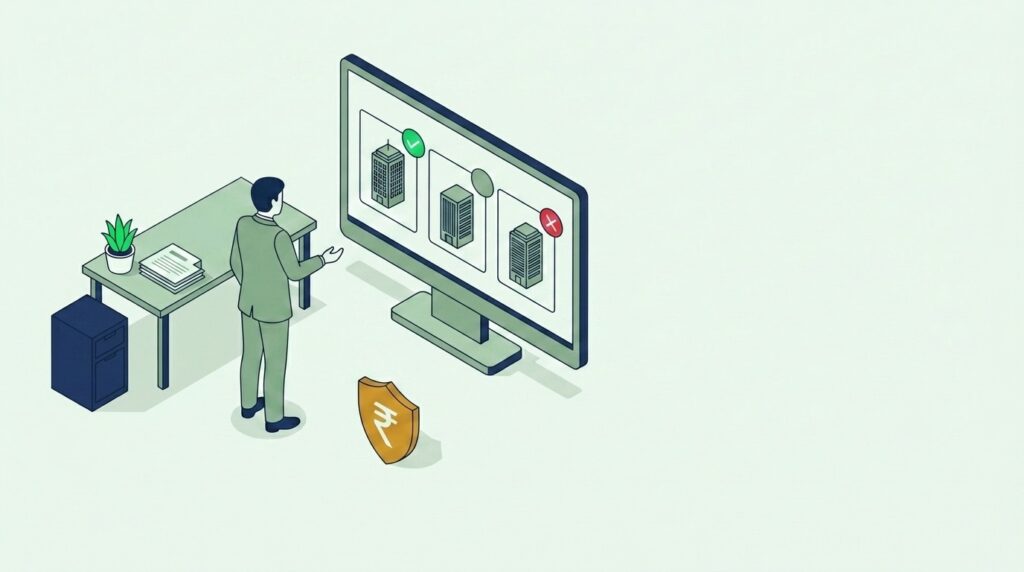
A supplier sends you a polished invoice, a GST number and a company name that sounds completely legitimate. You are about to release ₹4,00,000 of credit. Then you look the company up on the MCA database and find one word against it: “Struck Off”. That single field just saved you from chasing a refund from an entity that legally no longer exists.
Every company incorporated in India carries a status in the Ministry of Corporate Affairs (MCA) records — Active, Dormant, Under Process of Striking Off, Struck Off, Amalgamated, Dissolved and a few others. That status tells you whether the company is a live, compliant entity you can safely transact with, or a shell you should walk away from.
This guide explains where a company’s status lives, what each status actually means for you, how to run a company status check step by step, and the red flags that should stop a deal before it starts.
Why a Company’s Status Matters Before You Deal With It
A company’s status is a public, government-maintained signal of whether it is legally alive and filing its returns. You should treat it as a gate that every counterparty has to pass before you sign, pay or extend credit.
Consider what the wrong status exposes you to. A struck-off company has been removed from the Register of Companies — it cannot legally carry on business, sue or be sued in the ordinary way, or give you a valid commercial guarantee. A company “Under Process of Striking Off” is on its way out. A genuinely dormant company is not supposed to be running active operations at all. In each case, the status contradicts the picture a salesperson is painting for you.
The people who most need this check are doing ordinary due diligence: a vendor onboarding a new supplier, a buyer signing a long-term contract, a lender or investor sizing up a borrower, a job-seeker checking whether a hiring “company” is real, or anyone asked to share bank details with a name they have never heard of. The status field answers the first and most important question — does this company exist as a live legal entity — in seconds and for free.
Where the Status Lives: the MCA Master Data
The authoritative source is the company’s master data on the MCA portal. Master data is the registry snapshot the MCA holds against every registered company and LLP, and it includes the registered name, the date of incorporation, the registered office, the CIN, the authorised and paid-up capital, and — the field you care about here — “Company Status” (sometimes shown as “Company Status (for eFiling)”).
That status field is not marketing copy a company writes about itself. It is a regulatory label that changes only when something formal happens — the company gets incorporated, applies to go dormant, fails to file and is struck off, completes a merger, or winds up. That is exactly why it is trustworthy. If you want the full picture of every field in this record, see our guide on how to read MCA company master data.
You can reach the same master data in two ways: directly on the MCA portal’s “View Company/LLP Master Data” service, or through a third-party search such as WeeDoo that pulls the same registry data into a faster interface. Both are free to view. We will cover both below.
Common Company Statuses and What Each One Means for You
The status you see is more useful when you know what action it should trigger on your side. The table below maps the statuses you are most likely to encounter to a plain-language meaning and a recommended response. Treat the “What it means for you” column as a checklist, not legal advice — for a borderline case, confirm with a company secretary or chartered accountant.
| Status you may see | What it means | What it means for you |
|---|---|---|
| Active | The company is on the register and is the normal live status for a functioning company. | Safe to proceed on this point, but still verify name, CIN and filing history. |
| Dormant (under Section 455) | The company has formally declared itself inactive — typically holding an asset or a name with no significant transactions. | It is not meant to be trading. Be cautious if it is invoicing or taking orders. |
| Under Process of Striking Off | Strike-off has begun, either by the company or by the Registrar, but is not yet final. | Treat as a strong warning. Do not extend credit or sign long-term commitments. |
| Strike Off / Struck Off | The company has been removed from the Register of Companies and is no longer a live entity. | Do not transact. It cannot give you a valid commercial commitment in the ordinary course. |
| Amalgamated | The company has merged into another entity, which now carries on the business. | Identify and deal with the surviving company, not this name. |
| Under Liquidation | A winding-up or insolvency process is in progress. | High risk. Any dues line up behind a formal process — get professional advice first. |
| Dissolved | The company has been wound up and the legal entity has ended. | The entity no longer exists. Do not transact. |
| Converted to LLP | The private company converted into a Limited Liability Partnership. | The active entity is now an LLP — look it up under its LLPIN instead. |
Two practical notes. First, the exact label can vary slightly in how the portal phrases it, but the categories above cover what you will meet in everyday due diligence. Second, “Active” is a baseline, not a clean bill of health — it tells you the company is on the register, not that its filings are up to date. We return to that distinction in the FAQ.
How to Check a Company’s Status Step by Step
You need only one piece of information to start: either the company’s name or its CIN (Corporate Identification Number). Here is the company status check on the MCA portal.
- Go to the MCA portal and open the “View Company/LLP Master Data” service (under the MCA Services menu). This service is free and does not need a paid login to view the basic master data.
- Enter the CIN if you have it, or use the search feature to find the company by name and pick the correct entity from the results.
- Submit the captcha and open the record. Read the “Company Status” field against the registered name.
- Cross-check the surrounding fields — incorporation date, registered office, CIN — so you are sure you are looking at the right company and not a similarly named one.
If you would rather skip the portal’s captcha-and-form flow, you can run the same lookup through WeeDoo’s free MCA company and director search. Type the company name or CIN, open the result, and the status appears alongside the registered name, incorporation date and registered office — all sourced from the same MCA records, with no login required to view it.
Either route gets you to the same answer. The only difference is speed and convenience: the portal is the original source; a search tool is a faster front door to it when you are checking several companies in a row.
How to Confirm a Company Is Genuinely Registered
“How to check if a company is registered” is a slightly different question from “what is its status,” and a real fraud check answers both. A company can quote a name and a number that look official while none of it lines up in the register. Confirm all three of the following before you treat a company as genuine.
- A valid 21-character CIN. The Corporate Identification Number is the unique 21-character code MCA assigns at incorporation, and its structure encodes the listing status, industry, state, year and registration number. If the “CIN” you were given is the wrong length or does not resolve to a record, that is an immediate problem. Our guide on how to verify the 21-character CIN walks through the format.
- An Active status. The master data record should show the company as Active (or another live status that fits the relationship). Struck off, dissolved or under-strike-off means the entity is not one you can safely transact with.
- The registered name matching the name you were given. The legal name on the MCA record should match the name on the invoice, contract or letterhead — allowing for the usual “Private Limited” / “Limited” suffix. A mismatch can mean you are dealing with a different entity, a trade name with no company behind it, or an impersonation.
When all three line up — valid CIN, live status, matching name — you have confirmed the company is genuinely registered and currently on the register. For higher-value deals, go one step further and check the directors behind the company, since the same master data lets you see who controls it and whether they are tied to other struck-off entities.
Red Flags to Watch For
Most risky companies announce themselves in the master data if you read it carefully. The table below lists the signals that should slow a deal down and what each one is really telling you.
| Red flag | Why it matters |
|---|---|
| Status is Struck Off or Dissolved | The entity no longer legally exists. Anyone trading in its name is operating outside the company. |
| Status is Under Process of Striking Off | The company is being removed from the register. Commitments made now may be worthless soon. |
| Status is Dormant but the company is actively selling to you | A dormant company is, by declaration, not carrying on significant transactions. Active trading contradicts the status. |
| The CIN does not resolve to a record | The “company” may not be registered at all. A real CIN always maps to master data. |
| The registered name does not match the invoice or contract name | You may be dealing with a different entity, a bare trade name, or an impersonation. |
| Status is Active but no filings for years | Active is a register flag, not a compliance certificate. Long filing gaps can precede a strike-off. |
None of these is a guarantee of fraud on its own, but each one shifts the burden of proof onto the company. Ask for an explanation, and if it does not hold up, do not proceed.
Frequently Asked Questions
What does “struck off” mean for a company?
A struck-off company has had its name removed from the Register of Companies by the Registrar, usually for failing to file returns or for not carrying on any business. Once struck off, the company is no longer treated as a live entity — it cannot ordinarily carry on business or enter into normal commercial commitments. The status is the clearest signal in the master data that you should not transact with that entity.
Can you deal with a struck-off company?
You should not. A struck-off company has been removed from the register and is not a functioning legal entity, so contracts, credit and guarantees in its name carry serious risk. If someone is still trading under a struck-off company’s name, that is a reason to stop, not to proceed. If you have an existing dispute with a company that has since been struck off, take professional legal advice rather than relying on the company itself.
What is a dormant company?
A dormant company is one that has formally obtained dormant status under Section 455 of the Companies Act, 2013 — typically because it was formed for a future project, to hold an asset, or to reserve a name, and has no significant accounting transactions. It is a legitimate status, but it specifically signals that the company is not actively trading. If a “dormant” company is invoicing you or taking orders, the activity contradicts the status, and that is worth questioning.
How do you revive a struck-off company?
Restoration of a struck-off company is generally done by applying to the National Company Law Tribunal (NCLT) for the company’s name to be restored to the register, within the time limit the law allows. The process involves clearing outstanding filings and convincing the Tribunal that restoration is justified. It is a formal legal route, not a portal toggle, so a company secretary or company-law professional should handle it. Until restoration is actually ordered, the company remains struck off.
Is “Active Compliant” different from “Active”?
They point at slightly different things. “Active” in the master data means the company is on the register as a live entity. A separate compliance flag — companies often refer to the ACTIVE (INC-22A) requirement — relates to whether a company has filed certain particulars and is in good standing on that point. In short, “Active” tells you the company exists; a compliance flag tells you more about whether it has kept up with specific filings. Always read the actual status and filing history together rather than assuming “Active” means fully compliant.
The next time a name, an invoice or a contract lands on your desk, make the status field your first stop. A two-minute lookup that tells you a company is Active, Struck Off or Dormant is the cheapest due diligence you will ever do — and the one most likely to keep your money where it belongs.